
St Machar's Aberdeen, St Andrew's Inverness, and the former Nairn Campanile
8 Sep 1938 – 18 Dec 2025
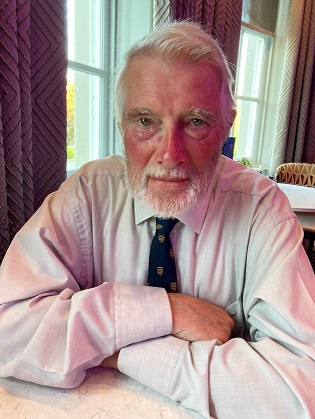
Peter Shipton was one of the most significant figures in Scottish ringing over several decades. There have only ever been twenty-six rings of bells in Scotland and Peter played a part in bringing four of those into existence – one in two different locations. A member of the Association from 1979 until his death last December, he served as Ringing Master from 1990 to 1993 and as President from 1996 to 2000. He also had two spells as the Association’s representative on the Central Council, the first between being Master and President, the second immediately after relinquishing that role. He put a lot of effort and commitment into keeping interest in the SACR going and helping others to develop their ringing, and during the period there was a significant increase in membership.
Peter learnt to ring as a teenager in Bedford and rang his first peal in 1954. The band consisted entirely of boys from Bedford Modern & Bedford Schools with an average age of just over seventeen. Forty years later, with one exception, the boys met to ring the peal again at the same tower. The experience must have been enjoyable because prior to going up to Cambridge University in 1958 he rang a further 25 peals. He rang a total of six peals for the Cambridge University Guild, including one at Dunkeld in 1996, it being the first in Scotland by the Guild, all by members resident in Scotland. In the 1960's he moved to the South Wales area where he was very active in the ringing scene locally and he rang numerous peals throughout the area. After moving to Scotland, despite living in the remoter parts of Grampian and the Highlands, with their relative lack of local towers and ringers, he steadfastly supported the Scottish Association and rang more than 100 peals for SACR over the next thirty years, forty-seven of them at St Machar, Aberdeen.
In 1984, when Martin and Maggie Whiteley moved to Aberdeen, they discovered that although there was no tower in the area, there were a few ringers, Peter amongst them. A handbell band was established, also including John Thorogood, meeting regularly in the Permanent Way Maintenance Engineers Office, a building in Aberdeen railway station’s shunting yards, now the Union Square shopping centre, in which Steven Munday was working. Martin and Steve proposed Peter for membership of the College Youths in 1985.
Discussion in the group turned to the idea of installing a ring of bells in St Machar’s Cathedral. This ambition came to fruition in 1987 when the redundant bells from West Ealing were acquired, restored and hung (with some difficulty) in the south tower. There was no obvious way to get the bells into the tower. The ground floor vestry at the base of the tower had a barrel-vaulted ceiling, so hoisting them straight up from there was impossible. There was no feasible access route through the church yard for a crane and there seemed no way of getting the bells through the louvres. Eventually Church of Scotland gave permission for a blocked-up window in the west wall to be opened, and through a sequence of complex manoeuvres, hoist each bell through the gap and up into the tower. Rumour had it that the last time the aperture had been opened was when a corpulent minister resident in that room had died and it was the only way to remove the corpse from the tower. Peter was a key player in helping to raise awareness and funds for the project, quite apart from his tireless efforts in helping to build the frame and create a new ringing room. Peter then took the lead in establishing a band at St Machar’s.
Soon after Peter acquired a set of Eijsbouts bells that had lain unused for decades and hung them in part of the Butterywell Farm buildings at Potterton, near Aberdeen. Such ‘mini-rings’ were very much in their infancy at the time, and hanging such light bells presented many new challenges of miniturisation, most of which had to be solved for the first time. The bells were soon augmented by two new trebles, also cast by Eijsbouts. Before these arrived, Potterton was the second lightest ‘conventional’ ring of six in the world: after, it became the lightest ring of eight. Nick Sturgess recalls his first visit to the bells: ‘The image of walking past a small number of farm animals, including Angora goats, in order to get to where the bells were rung in a farm steading still remains with me.’
In the mid-1990s, Peter was instrumental in helping the SACR to acquire the bells from Dunecht House that were later installed at Haddington. Through his contacts, he also arranged the lorry to collect the bells from Dunecht and took them into storage for a while at Butterywells Farm while a suitable home was being sought.
In the late 1990s, shortly before moving to Nairn, Peter provided guidance to Bishop Mario Conti and the authorities at St Mary’s of the Assumption, Aberdeen, where essential tower repairs and the availability of substantial grant funding, made an augmentation and rehanging of the existing bells possible. After the bells were rehung, Peter set to work training a band, comprised mainly of boy scouts. Sadly, further work on the tower was required, and following Peter’s move, enthusiasm waned.
The mini-ring was transported to form the world’s most northerly ring of bells at Druim Croft, Nairn in a new purpose built steel and wooden structure. Peter became a member of the Inverness Cathedral band, regularly travelling the relatively short (by Scottish standards) distance along the A96 to Inverness for Sunday service and practice night ringing.
Away from ringing Peter led an extraordinarily active life. After graduating from Cambridge, where he rowed for his college, he went on to gain a PhD at Reading in the late 1960s. This was followed by a two-year post-doctoral research position at Washington State University before taking up an appointment at Aberdeen University’s School of Agriculture in 1972. His specialism lay in wheat and soil borne diseases. He took a sabbatical at the University of Sydney in Australia 1976-77 followed in 1979 by a three-month stint in Brazil with the World Food Organisation, again focusing on soil borne diseases. He finished at Aberdeen in the early 1980s and thereafter became an independent consultant with a wide range of clients across Scotland and was involved in the early days of organic farm inspections. John Thorogood recalls being enlisted to fly him over Aberdeenshire examining crops on various farms to which he was acting as an advisor.
Peter was the godson (and first cousin, once removed) of the famous Himalayan mountaineer Sir Eric Shipton. He was an active climber himself and had a passion for cross-country skiing, as well as downhill skiing at Glenshee. He was keenly involved in the early days of the Lecht Ski Company from its earliest days, asking penetrating questions as a shareholder at AGMs about the centre’s environmental impact. One year he managed to ski on snow in Scotland in every month of the year. He was also an avid sailor, sailing at Stonehaven and on the Loch of Skene, near the Dunecht Estate, for many years.
Inverness ringers used to attend a monthly practice at Druim Croft and were always appreciative of Peter and Aileen’s hospitality, both making sure everyone was always well fed and watered prior to any ringing on the mini-ring, as well as afterwards!
Following a visit to China, Peter suffered heart failure and became a less frequent ringer at Inverness and hardly rang his own bells at all when ringers visited Druim Croft. He had problems gripping the rope and couldn't stand unsupported for more than a short touch. He would, instead, listen to other’s attempts to master his little bells, either from the garden or from the comfort of his conservatory. The Druim Croft tower was taken down in December 2017 when Peter and Aileen moved to a rural location in Ayrshire to be nearer to close family members.
Peter Shipton will be remembered as a kindly, modest and hospitable man who made a considerable contribution to ringing in Scotland over a long period of time.
This obituary was compiled from memories of Peter’s life from: John Thorogood, Martin Whiteley, Nick Strurgess, Clare Caley, Nigel Booth, Bob Hancock, Ruth Marshall and Philip Gay.